


A folk saying passed down for a thousand years in Dong'an County, Yongzhou goes that "Si Yue Ba, eating black rice." On the eighth day of the fourth Chinese lunar month every year, local households fire up their stoves to brew a pot of black rice with herbs grown in the mountains, expressing their earnest anticipation for peace, good fortune, and a happy life.
This traditional delicacy, also known as "Lixia Rice" or "Start of Summer Rice," not only embodies the life wisdom of ancestors, but also contains a natural health code for strengthening the spleen, relieving cough, calming the mind, improving eyesight, dispelling dampness, repelling mosquitoes, nourishing hair, and beautifying the skin. The fresh aroma of black rice comes from the herbs grown in the deep mountains.

Local people pick the raw materials for black rice. (Photo/Deng Zhiyu)
As the season approaches, villagers in Dong'an County go into the mountains in groups, searching for various fresh herbs such as black rice leaves, maple leaves, and jianfengxiang, a kind of herbaceous plant. After washing the herbs, they pound the materials to extract the juice, and then soak glutinous rice in this dark brown natural herbal juice. After several hours of soaking, the rice grains absorb the natural color and fragrance and turn glossy jet-black.
Traditional cooking methods are followed when making the black rice. First, people stir-fry ginger, pork belly, and fermented black beans to enhance the aroma. Then the black rice is added and stir-fried along with the spices, and steamed with polygonatum. The finished product is shiny and dark as jet, combining the freshness of herbs and the sweetness of glutinous rice. It is a traditional treasure rooted in the principle of "homology of medicine and food."
Though times change, the tradition never faded. Instead, it has been revitalized through innovation. To better integrate this intangible cultural heritage skill into modern life, Dong'an County adheres to the core of ancient craftsmanship, while boldly breaking through traditional consumption scenarios. A series of innovative products has been developed such as black rice zongzi, black rice with dry fruit, black rice baozi (steamed bun with fillings), and black rice dumplings.
Today, black rice is no longer a festival food reserved for a dedicated date, but has become a healthy daily delicacy. For example, black rice balls make a quick and easy breakfast; black rice dumplings are novel and tasty; and gift-packed black rice zongzi are an excellent choice for visiting relatives and friends. Thereby, this thousand-year-old folk custom has continued in a way that is more closely integrated with people's daily life.
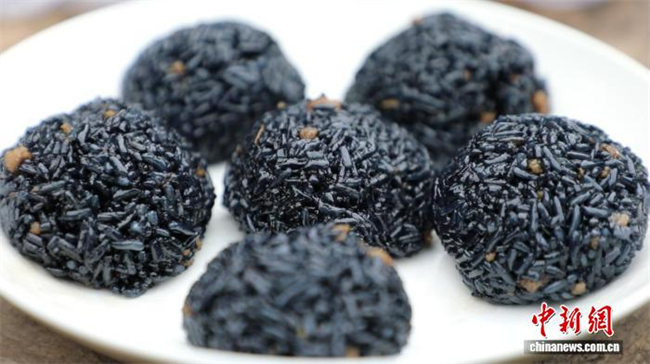
Black rice balls. (Photo/Deng Zhiyu)
"'Si Yue Ba, eating black rice' is a precious cultural treasure for Dong'an. We have the responsibility to pass on this flavor," said Li Xuemei, the representative inheritor of the black rice making technique in Damiaokou, Dong'an County.
Over the past years, many intangible cultural heritage inheritors represented by Li Xuemei have steadfastly adhered to ancient craftsmanship, deeply engaging in the culture of herbal food and health preservation, and preserving the original flavor. They have not only passed down traditional skills from generation to generation, but also leveraged innovative R&D and e-commerce to help Dong'an black rice go beyond the mountains and reach the whole country.
This article is from the Hunan Provincial Government www.enghunan.gov.cn.
Translator: Pang Yuehui
Chinese source: Chinanews




 Hunan PSB Cyber Security Filing: No. 43010302000524