

History and Culture
Home > About Hunan > Cultural Heritage
Exploring Intangible Cultural Heritage in Ancient Villages of Miao and Dong Villages
Recently, a journalist delegation of the 5th Hunan Tourism Development Conference visited Gaoyi Ancient Village in Huitong County, Yanjiao Dong Village in Jingzhou Miao and Dong Autonomous County, and Huangdu Dong Cultural Village in Tongdao Dong Autonomous County, all of which are located in the southern part of Huaihua City, Hunan Province. The journalists experienced up close the integration of farming-and-reading culture with Han, Miao and Dong architectural arts, as well as the unique charm of multi-ethnic festival customs and intangible cultural heritage.
Gaoyi Ancient Village is surrounded by mountains on three sides and facing water on one side, the overall terrain resembles a high-back wing chair, hence the name Gaoyi (high chair in Chinese literally). As one of the best-preserved ancient villages from the Ming and Qing dynasties in southern Hunan, it not only retains a large number of ancient architectural relics but also carries on rich folk culture. The Nuo opera "Gang Pu Sa" is one of the most representative cultural symbols of Gaoyi Ancient Village. "Gang Pu Sa" is an ancient form of Nuo opera performed by shamans. Its repertoire mostly tells stories of deities, with simple yet mysterious plots. It showcases a high degree of integration between primitive religious atmosphere and folk art, serving as a "living fossil" for the study of local beliefs and theatrical culture.
In addition, black rice is also a characteristic intangible cultural heritage delicacy in Gaoyi Ancient Village. Villagers collect specific plants to make a juice, soak glutinous rice in it, and then steam the rice. The steamed rice is glossy black and fragrant. In recent years, with the advancement of cultural tourism integration, a series of black-colored delicacies such as black glutinous rice cakes, black puffed rice, and black rice dumplings emerged, attracting numerous tourists to taste the experience and becoming a bright calling card for local cultural tourism.
In Yanjiao Dong Village, Jingzhou Miao and Dong Autonomous County, the craftsmanship of carved preserved fruit is truely remarkable. Luo Xianmei, a representative inheritor of this intangible cultural heritage, displayed her finished carved green pomelo works and said, "Carved preserved fruit integrates culinary culture and ethnic culture. It is an art on the tip of the tongue." This craft uses unripe green pomelo as the main raw material, and processes the pomelo through multiple processes including slicing, carving, rinsing, boiling, sugaring, and drying. The carved patterns include exotic flowers and plants, birds and animals. The compositions are full, the shapes vivid, the craftsmanship unique, and the patterns numerous. The carved preserved fruit is both edible and ornamental, fully reflecting the Dong people's pursuit of beauty and wisdom in life.
In Huangdu Dong Cultural Village, Dong brocade can be seen everywhere. Dong brocade is not only a part of traditional attire but also an important symbol of Dong culture. "Dong brocade is people's observation of nature and all things," said Su Tianmei, a representative inheritor of this intangible cultural heritage. Weaving a piece of Dong brocade involves more than ten manual steps, including cotton ginning, spinning, dyeing, thread twisting, warp arranging, and brocade weaving. The process is complex, time-consuming, and labor-intensive. The patterns of Dong brocade are rich and varied; common motifs include magpies, horses, dragons and phoenixes, symbolizing good fortune and beauty. These patterns are not naturalistic representations but recreate ethnic memory through abstraction, generalization, and exaggeration. They preserve the essence of thousand-year-old traditional Dong crafts, presenting an artistic style that is noble, simple, delicate, and elegant.
Relying on five locations — Gaoyi Ancient Village, Yanjiao Dong Village, Huangdu Dong Cultural Village, Disun Miao Village, and Feishan Scenic Area — Huaihua City has created the "Ancient Villages of Miao and Dong Villages" intangible cultural heritage tour route. Since its operation, this route has received a total of 3.119 million visits. Among them, Huangdu Dong Cultural Village has welcomed over one million visitors, while the other sites each receive an average of around 500,000 visits annually. The total annual tourism revenue has reached 500 million CNY.
With the city as the foundation, culture as the soul, and tourism as the form, Huaihua is actively exploring a new model of intangible cultural heritage preservation through "culture + tourism." Taking the opportunity of the 5th Hunan Tourism Development Conference, the city has innovatively launched a "Experiencing intangible cultural heritage (ICH), Earning Points, Enjoying Huaihua" cultural tourism consumption model, building a new "ICH+" integrated development system. It promotes the integration of ICH with the entire chain of "eating, accommodation, transportation, sightseeing, shopping, and entertainment," attracting more tourists to Huaihua to immerse themselves in the cultural heritage and unique charm of this land.
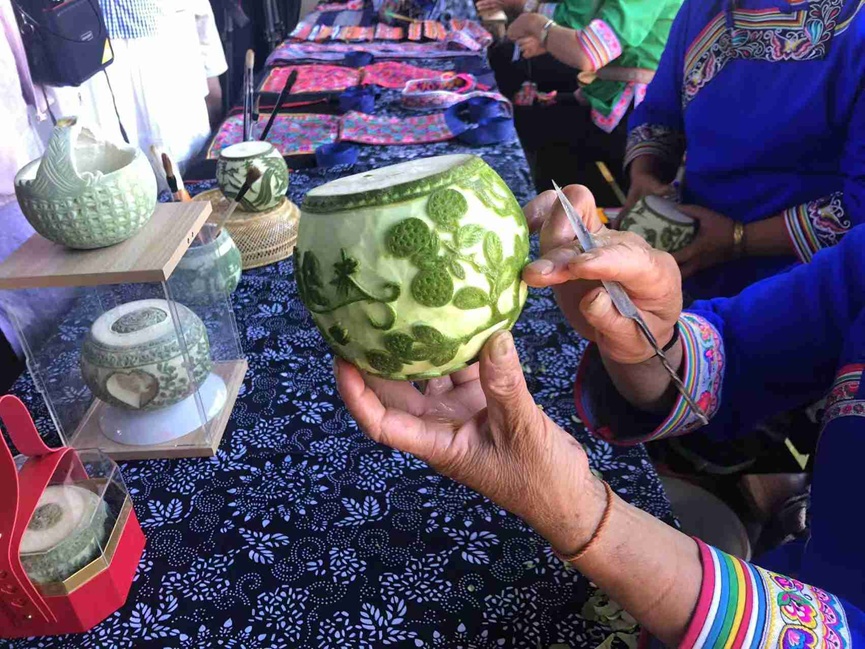
A finished carved green pomelo. (Photo/Xie Yuxin)
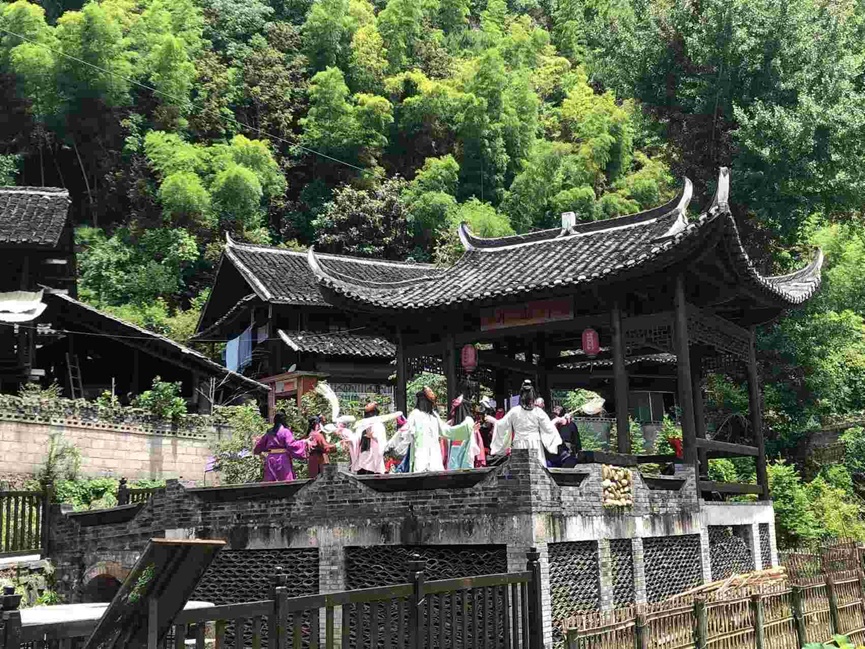
The Nuo opera "Gang Pu Sa." (Photo/Xie Yuxin)
Chinese source: People's Daily Online