

History and Culture
Home > About Hunan > Cultural Heritage
Jiangyong Nvshu: from Boudoirs to the World's Admiration
"There are tens of thousands of splendid writings in the world, yet I never believed any truly unique text could exist. The talented women of Yongming, well-versed in learning, compiled and passed down their script, read and cherished through the ages to this day.” This mysterious script is hidden away in southwestern Hunan, where the millennium-old Nvshu has been quietly inherited.
Nvshu is the only surviving female script in the world. It is mainly preserved in Puwei Village, Shangjiangxu Town, Jiangyong County, Yongzhou City, Hunan Province. However, the exact time of its origin and the identity of its creator remain a mystery to this day.
Nvshu is a phonetic script that records the local Yongming dialect. Its characters are elongated and rhombus-shaped, slender and graceful, with even strokes. Each character resembles an elegant and ethereal woman. It consists of approximately 500 to 700 original characters. Alongside Nvshu calligraphy, the Nvshu-related customs, including "Zuo Ge Tang" and "Ox Fighting Festival", have been inscribed into China's first batch of National Intangible Cultural Heritage list.
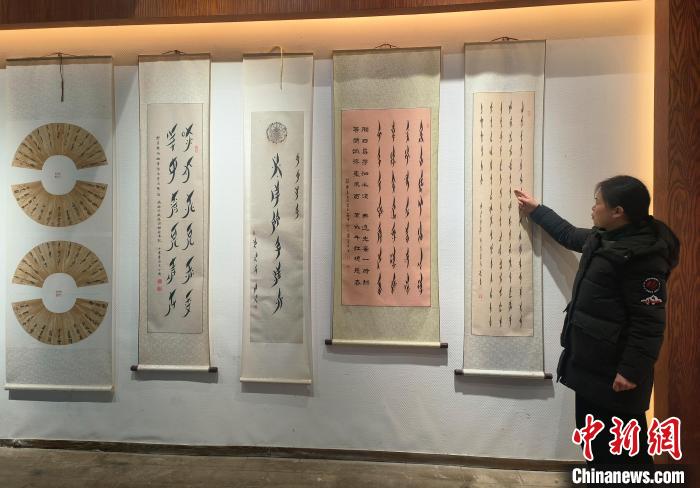
In March 2025, a Nvshu inheritor introduces a piece of Nvshu calligraphy at the Jiangyong Nvshu Garden. (Photo/Tang Xiaoqing, China News Service)
On midsummer days in June, groups of domestic and international visitors came to the Nvshu Garden in Puwei Village, learning to write Nvshu characters and sing Nvshu songs. Hu Meiyue, an inheritor of the Nvshu tradition, gives over 10 classes to visitors in a single day. She is the granddaughter of the late natural Nvshu inheritor Gao Yinxian. By the age of ten, Hu could already read, write, and sing Nvshu.
In Hu Meiyue's memory, her grandmother had many handwritten Nvshu works, including The Flower Girl, The Story of Third Aunt, and The Book of Admonitions, among others. "Grandmother had six sworn sisters and often took me to their gatherings. Everything they looked at, read, sang, and embroidered was in Nvshu," Hu said. Each Nvshu character carries multiple meanings and was often written on paper or folding fans, or embroidered on handkerchiefs and woven into floral bands. The women's practice of singing and studying Nvshu was called "reading paper," "reading fan," and "reading handkerchief."
Early Nvshu works were mostly autobiographies of women, often filled with sorrow and lament. Through creating and exchanging their respective Nvshu works, they poured out and released their inner pain, seeking spiritual resonance and consolation. Because of the custom of "burning the writings upon the writer's death" and the successive passing of natural Nvshu inheritors, Nvshu was once on the verge of extinction.
In the early 1980s, experts and scholars such as Gong Zhebing, a lecturer at South-Central Minzu University, and Zhao Liming, a professor at Tsinghua University, unveiled Nvshu to the world, thereby lifting the veil of mystery that had long surrounded it.
"Research institutions and scholars from both home and abroad came to Jiangyong for field investigation. They called Nvshu 'a script puzzle from boudoirs,' and fully affirmed its research value across multiple disciplines, including linguistics, sociology, folklore, and literature. Its social functions continue to be applied in modern civilization," said Luo Xiaoge, a professor at Hunan University of Technology and Business who studies Nvshu. According to Luo, Nvshu characters, Nvshu script, Nvshu songs, and women's handiwork together constitute the Nvshu customs — a unique form of female culture.
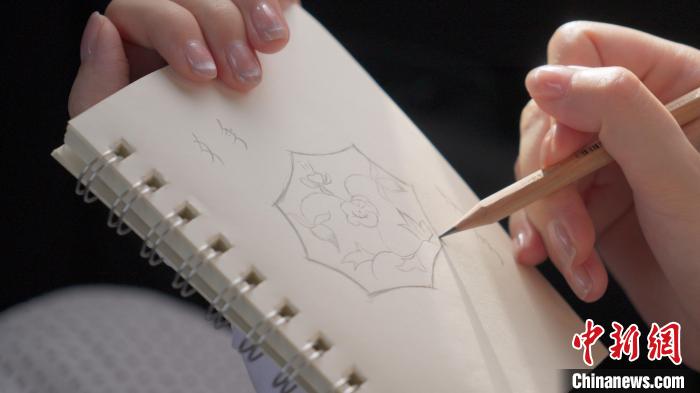
In April 2025, jewelry designer Gao Juan visited Jiangyong, where she drew the octagonal flower — the spiritual totem of the "gentlewoman" in the world of Nvshu. (Photo provided by the interviewee)
At present, Jiangyong County has revitalized Nvshu customs such as "reading paper and reading fan," the Huashan Temple Fair, the Ox Fighting Festival, sworn sisterhoods, and "Zuo Tang Ge," gradually shifting from protecting Nvshu alone to the holistic preservation of its cultural ecology. Academically, Nvshu research bases have been established, represented by institutions such as Tsinghua University, Wuhan University, South-Central Minzu University, and Hunan Women's University. The International Encoding Character Set for Nvshu has enabled Nvshu to truly enter the ranks of international linguistic norms.
As the cultural influence and visibility of Nvshu continue to grow, Jiangyong Nvshu has been featured in over 120 cultural exhibitions both in China and abroad, and has been showcased at the United Nations Chinese Language Day events. Symphony of 13 Microfilms: Nvshu, composed by Tan Dun, has been performed in 34 countries and regions.
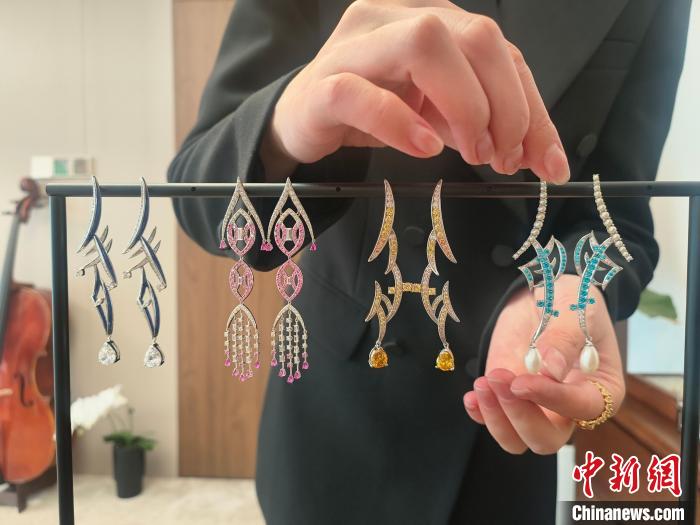
In March 2025, jewelry designer Gao Juan displays a pair of earrings designed with the Nvshu characters for "spring, summer, autumn, winter" (from left to right) in Changsha, Hunan Province. (Photo by Tang Xiaoqing, China News Service)
Jiangyong Nvshu has also gradually integrated into the era and everyday life. Nvshu-themed mooncakes, Spring Festival couplets, and New Year's greeting cards have become popular gifts for visiting relatives and friends. Creative cultural products such as Nvshu nail art, bookmarks, round fans, ceramics, and phone cases have become fashion items among young people. Clothing, bags, jewelry, and other items featuring Nvshu elements frequently appear at international shows.
"At first, I was drawn to the unique form of Nvshu characters. After delving deeper, I was deeply moved by the gentle yet resilient spirit of Nvshu culture," said Gao Juan, a post-90s jewelry designer. She named the four pairs of earrings she designed using the Nvshu characters for "spring, summer, autumn, winter" as the "Four Seasons of Nvshu" series, symbolizing the cycle of the seasons and expressing the endless continuity of Nvshu.
Chinese source: Chinanews