


A century ago, a group of young Hunanese students set off from Changsha for France to participate in the Diligent Work-Frugal Study Movement, seeking new knowledge along the banks of the Seine. A century later, a group of middle school students from Changsha have traveled to Montargis—the very city where those early Hunanese students once gathered—for educational exchanges, staying with French host families. These two generations echo across time and space, and the "dialogue" between the Xiangjiang River and the Seine has continued uninterrupted for a hundred years.
Nestled in central China, the inland city of Changsha shares a bond with Europe that is far deeper than one might imagine. After Changsha opened as a treaty port in 1904, several European countries established consulates, foreign trading firms, and customs agencies here. European-style buildings, such as the Former Residence of the Commissioner of Changsha Customs on Orange Isle, still stand as quiet witnesses to these early commercial exchanges. Today, from the China-Europe (Changsha) freight trains traversing Asia and Europe, to the two-way collaboration between "Changsha Intelligent Manufacturing" and European enterprises, Changsha is writing a new chapter of opening up. By utilizing transport corridors as its lifeline, industry as its foundation, and cultural exchange as its bridge, the city is steadily connecting with Europe and embracing the world.
Spanning Asia and Europe: China-Europe (Changsha) Freight Trains Forge a Two-Way Trade Artery
Bathed in the morning light, a China-Europe freight train fully loaded with construction machinery, automobiles, and auto parts slowly departed from the Changsha International Railway Port, embarking on a journey of thousands of miles to Europe.

A China-Europe freight train departs from Changsha. (Photo/Cai Zhen)
A century ago, young Hunanese students "ventured across the seas in search of knowledge." Today Changsha is leveraging the China-Europe freight trains to forge a stable overland trade corridor to Europe. To date, the China-Europe (Changsha) freight train service has operated over 7,400 trains, maintaining a steady schedule of two trains per day, and scaling up to three or four during peak periods. Operating across 75 primary routes, the network now reaches more than 100 cities in 30 countries across the Eurasian continent.
As a global hub for the construction machinery industry, Changsha is home to leading enterprises like Sany, Zoomlion, and Sunward, whose products have established a strong presence in Europe's infrastructure market. Meanwhile, complete vehicles and components from automakers such as BYD and Geely are also being exported to Europe in bulk via the freight trains. In 2025, the China-Europe (Changsha) freight train service operated 188 customized trains, ensuring the steady transport of construction machinery, complete sets of auto parts, electronic instruments, home appliances, and Hunan tea to European markets.
In May of this year, the first China-Europe freight train dedicated to cross-border e-commerce departed from Changsha North Station. Carrying 50 standard containers of daily consumer goods such as luggage, apparel, and home textiles, the train traveled through the Horgos port to Małaszewicze, Poland, enjoying expedited customs clearance under the "9610" cross-border e-commerce model. As a core transshipment hub for the EU, Małaszewicze enables the rapid distribution of goods to Germany, France, the Netherlands, and beyond. This route effectively bridges the gap in overland logistics for cross-border e-commerce in China's central inland regions.
The two-way cargo corridor of the China-Europe (Changsha) freight train service began to take shape with the arrival of its first inbound timber train in 2019. Wang Jianhua, a second-level inspector at the Logistics and Port Office of the Changsha Municipal People's Government, noted that inbound trains currently primarily carry European timber and Central Asian grain. Consequently, Changsha has emerged as a major domestic hub for timber and grain imports. Moving forward, the city will leverage its overseas consolidation centers in Minsk and Moscow to implement front-loaded cargo consolidation. This will facilitate the steady import of European agricultural and food products—such as grains, edible oils, dairy, wine, and meat—while expanding the import of industrial intermediate goods, including high-end equipment components, auto parts, chemical raw materials, and pulp.
Wang added that the China-Europe (Changsha) freight train service will continue to upgrade the capacity and efficiency of this trade corridor. Key initiatives include optimizing the fully scheduled train service from Changsha to Poznań, solidifying the main routes to Minsk and Moscow, and leveraging the building of a national consolidation center to cover more European distribution centers. Meanwhile, the inbound trains will mainly carry timber and grain, while increasingly transporting European agricultural and food products, auto parts, and industrial goods.
A Two-Way Industrial Embrace: Deepening Economic, Trade, and Investment Cooperation
Inside the embodied AI training center of ZValley Technology Co., Ltd. (ZValley), a subsidiary of Zoomlion, dozens of humanoid robots are practicing grasping and sorting tasks. Not far away, in the testing workshop of the Changsha Eulon Robot Co., Ltd. (Eulon), R&D personnel wear independently developed exoskeletons to fine-tune their movement-assistance performance.
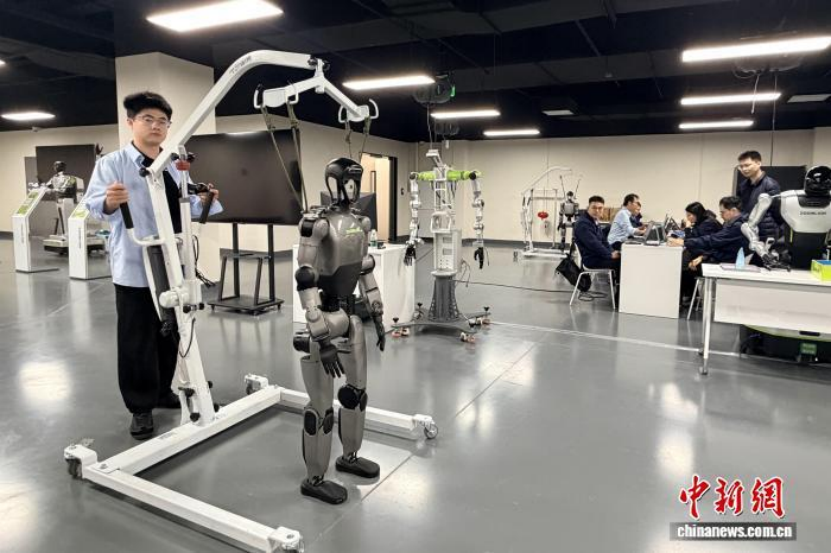
A technician trains an embodied AI robot from ZValley. (Photo/Feng Jun)
These two local tech innovators have independently set their sights on the European market. In April this year, ZValley's embodied AI operating system made its global debut at Hannover Messe in Germany, and its humanoid robot Z01 was subsequently showcased at KOMATEK 2026 in Istanbul. Meanwhile, Eulon has designated Europe as its first overseas market, with over 2,000 sets of its "Youlong" flexible exoskeleton robots shipped to France, Italy, the UK, and other countries since October.
Sinocare, a Changsha-based medical device manufacturer, is deepening its presence in Europe through cross-border e-commerce. The company has launched independent websites in German, French, and Spanish languages, and has established overseas warehouses in multiple countries to achieve localized logistics. "Europe has a steady demand for blood glucose monitoring products. By leveraging the 'cross-border e-commerce + brand + overseas warehouse' model, we continue to enhance our service capabilities," said Li Qingyan, international sales director at Sinocare. He noted that the company boasts over 25 million global users, with its blood glucose monitoring products consistently ranking among the top in their category on major e-commerce platforms across Europe and Southeast Asia.
As a pivotal city in the region along the middle reaches of the Yangtze River, Changsha is accelerating the development of the China-Europe International Cooperation Demonstration Zone. The German Small & Medium Enterprises Cluster Zone (Hunan) has been established in Changsha, complemented by platforms such as the China-Europe Joint Innovation Center for Enterprises and the Sino-Germany (Hunan) Intelligent Manufacturing Innovation Center. European industry giants, including Germany's Schaeffler and Continental, and France's Saint-Gobain, Faurecia, and Schneider Electric, are expanding their footprint in Changsha, focusing on high-end manufacturing, automotive components, and intelligent equipment. To date, Changsha has attracted 30 German-invested enterprises. Companies such as Bosch and SEG Automotive have successively set up R&D centers in Changsha, creating a robust ecosystem characterized by the demonstration effect of leading enterprises, the empowerment of clustered R&D platforms, and the coordinated development of supporting industries.
Data from the Changsha Municipal Commerce Bureau shows that Changsha's trade with Europe reached 33.33 billion CNY in the first eight months of this year, a year-on-year increase of 15.8%. With corridors, industries, investment, and trade closely intertwined, the two-way interaction between the Xiangjiang River and the Seine is now advancing from "unimpeded flow of goods" to "shared industrial prosperity."
The Xiangjiang River "Dialogues" with the Seine: Deepening Mutual Learning Between Civilizations
If economic and trade ties form the solid "skeleton" of this relationship, it is cultural and people-to-people exchanges that inject warmth into Changsha, a City of Media Arts in the UNESCO Creative Cities Network.
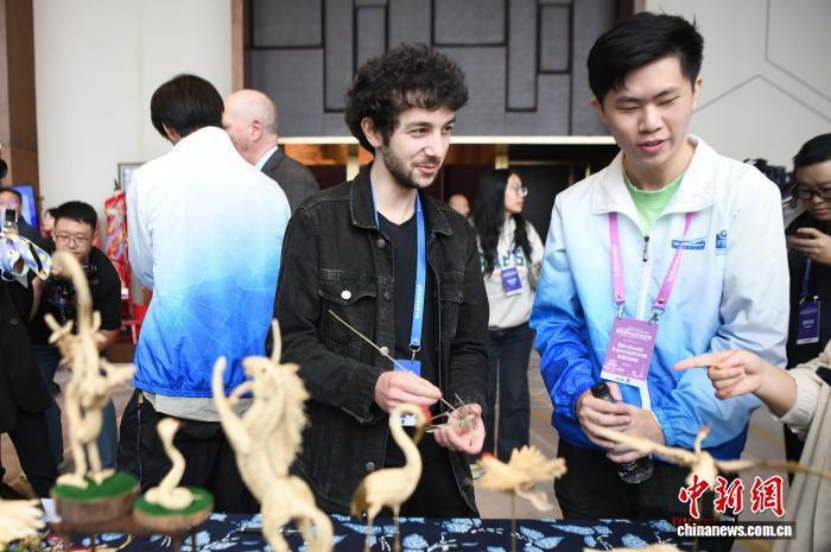
French guests learn about Changsha palm fiber weaving crafts during the 7th China-France Cultural Forum in Changsha. (Photo/Yang Huafeng)
The sister-city bond between Changsha County and Montargis, France, is a direct continuation of the century-old historical tie from the Diligent Work-Frugal Study Movement. This small French city is home to the Chinese Work-Study Movement Museum in Montargis, which was paired with the Former Residence of Li Weihan in Changsha County as friendly memorial museums in 2023. In the spring of 2025, the first group of students from the Changsha County No. 1 Middle School traveled to a school in Montargis for an exchange program, staying with local host families. That April, students from Montargis participating in the "Chinese Bridge" program visited Changsha, experiencing bamboo weaving, calligraphy, and Tai Chi. In February 2026, the two schools officially signed a sister-school agreement, stipulating a renewal every three years.
"It was only by living in the homes of French students that I truly understood what it means for 'civilizations to blend through exchange,'" said a teacher who led a student delegation to France. "French students experienced the charm of the East through bamboo weaving and Tai Chi, gaining a deeper understanding of China through the vibrant, everyday life in Changsha. The seeds of friendship have truly taken root among the youth."
An even broader stage for cultural exchange continues to unfold. In November 2025, the 7th China-France Cultural Forum was held in Changsha, featuring 15 events spanning culture and tourism, AI-driven cultural creativity, and dialogues among young artists. The forum was attended by 78 French guests, including former French Prime Minister Jean-Pierre Raffarin. Meanwhile, branded events such as the "Croisements Festival" and the "Franco-Chinese Month of the Environment" are regularly hosted in Changsha, while Hunan's intangible cultural heritage items, including Hunan Embroidery and Hunan Opera, have repeatedly graced European stages.
"We are committed to 'going global' to promote our city and 'inviting in' international partners for familiarization visits, continuously deepening practical cultural and tourism cooperation with Europe and expanding our international circle of friends," said Wang Hongting, deputy director of the Promotion, Communication, and Exchange Cooperation Division at the Changsha Municipal Bureau of Culture, Tourism, Radio, and Television. In recent years, Changsha has conducted cultural and tourism promotion tours in the UK, the Netherlands, Croatia, and Finland, and has hosted dedicated promotional events in Bristol. Additionally, the city has invited Visit West, the official tourism board for the West of England, and nearly 100 European travel agencies to Changsha for familiarization trips, effectively opening up new channels for European tourist arrivals.
Market feedback provides a direct testament to the success of these exchanges. Data from Ctrip shows that in 2025, the UK, Russia, Germany, and France ranked among the top 20 inbound tourist source countries for Changsha. In the first half of 2026, Italy and Spain were added to the list, further expanding Changsha's European tourism footprint.
The Xiangjiang River flows north, while the Seine flows west; the long-distance dialogue between these two rivers has never ceased. Today, Changsha continues to consolidate the foundation for two-way interaction and mutually beneficial cooperation between China and Europe, bound together by the triple ties of transport corridors, industrial collaboration, and cultural exchange.
Source: en.changsha.gov.cn




 Hunan PSB Cyber Security Filing: No. 43010302000524