


The 2026 "From Ziquejie Terraces to the World" — the 4th Global Farming Culture Exchange and Mutual Learning Conference and the 10th Conference of the East Asia Research Association for Agricultural Heritage Systems are being held in Loudi City, Hunan Province.
In an interview with China News Service in Xinhua County, Hunan Province, Koji Nakamura, advisor to the Noto GIAHS Biodiversity Working Group in Japan and co-chair of the East Asia Research Association for Agricultural Heritage Systems (ERAHS), expressed the hope that more Japanese youth could be sent to China for visits in the future. He also welcomed young people from China and South Korea to Japan for exchanges, so that youth from the three countries can build genuine connections in the fields.
Koji Nakamura pointed out that a rapidly aging population and a shrinking agricultural population are common challenges in development. "We must preserve traditional farming methods, reduce pesticide use, and protect biodiversity and local cultures, while also revitalizing agriculture on this foundation," he said, adding that although national circumstances vary, these common issues are worth exploring together.
China, Japan and South Korea have long cooperated in the field of agricultural heritage. As early as 2013, the three countries began building a cooperation mechanism for agricultural heritage in East Asia. Currently, among the 104 Globally Important Agricultural Heritage Systems (GIAHS) sites, China, Japan, and South Korea together account for 51.
LEE Yoo Jick, a professor at Pusan National University and co-chair of ERAHS noted that exchanges with China have played a significant role in South Korea's efforts to establish a nationally important agricultural heritage system and promote GIAHS applications. He expressed the hope that the two countries will jointly explore new directions for the development of agricultural heritage in the future.
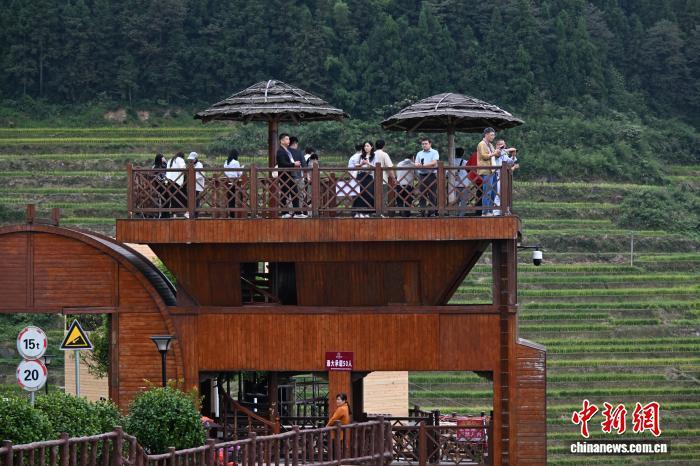
On September 11, tourists enjoy the scenery from an observation deck at the Ziquejie Terraced Fields in Xinhua County, Loudi City, Hunan Province. (Photo/Zhao Jianbin)
"The origins of agriculture in the three countries share commonalities, and comparative research can help address some of the common challenges facing the world." Min Qingwen, researcher at the Institute of Geographic Sciences and Natural Resources Research of the Chinese Academy of Sciences and executive chairman of ERAHS, cited the example of the "Terraced Fields Guardian" public welfare adoption initiative launched in Xinhua. This initiative aligns perfectly with Japan's farmland adoption and volunteer systems, as both attract urban youth to the countryside to experience farm work through low-threshold sponsorship, immersive experiences, and full-cycle services.
The president of the Korea Rural Community Corporation said that income growth is key to encouraging young people to return to rural areas. He explained that the Republic of Korea is leveraging its agricultural heritage to revitalize rural regions and increase farmers' incomes. Banks are entrusted with taking over farmland from retired farmers and leasing it preferentially to the younger generation of new farmers, while the government provides support through fiscal and institutional measures.
"Agricultural heritage sites have their own 'scarcity,'" said Min Qingwen. By tapping into their ecological and cultural value, agriculture can evolve from mere production into a vehicle for ecotourism and rural tourism, providing young people with employment opportunities and income that surpass those in cities. Only then will young people be attracted to start businesses and work in rural areas, thereby solving the problem of who will cultivate the farmland in the future.
This article is from Hunan Provincial Government. www.enghunan.gov.cn.
Translator: Xiao Juan
Chinese source: Chinanews




 Hunan PSB Cyber Security Filing: No. 43010302000524