


"This is my first visit to Huaihua, but I've already deeply felt the warmth and vitality of this city," said Chamlak Kanphet, deputy governor of Nong Khai Province, Thailand. On September 20, a delegation from Nong Khai Province, Thailand, visited Huaihua, embarking on an in-depth exchange journey of economic and trade cooperation and industrial coordination. In a media interview, Chamlak Kanphet spoke highly of Huaihua's urban development, business environment, and collaboration potential. He expressed keen expectations for pragmatic cooperation between the two places in the future.
Chamlak Kanphet noted that he felt the warmth of the people of Huaihua upon arrival, and this sincerity and efficiency left a deep impression on him. "Not only are the people friendly and kind, but the entire city has also impressed me greatly. The streets are clean and tidy, public security is good, and infrastructure is highly modernized, presenting the image of an inland open city full of development potential."
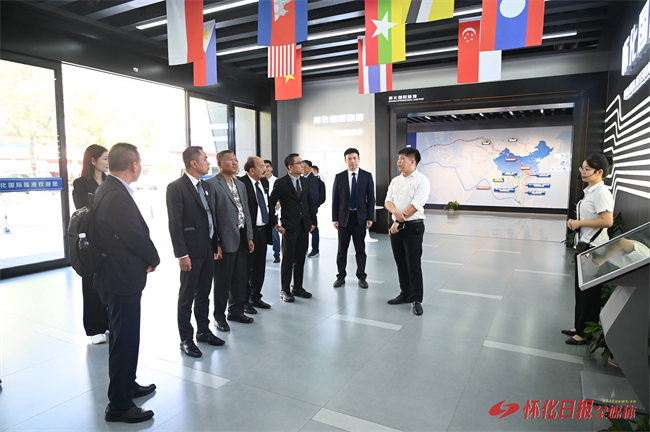
Nong Khai Province is the northeastern gateway of Thailand, facing Vientiane, Laos across the Mekong River. It is a frontier hub for Thailand to connect with the China-Laos Railway land corridor and has geographical advantages for developing cross-border trade and processing. Its main industries are agriculture, border trade, and tourism.
The Huaihua International Land Port is the core hub at the eastern route of the New International Land-Sea Trade Corridor and the only freight assembly center in Hunan linking ASEAN. Located in the hinterland in central China, the port connects the east with the west and links the south with the north in China, serving as a gateway hub for the central regions of China to connect with the ASEAN land corridor.
The Huaihua International Land Port has opened seven international logistics routes, obtained the United Nations Code for Trade and Transport Locations (UN/LOCODE), and its business covers many ASEAN countries. In the past three years, its train operations have steadily expanded, with the number of China-Laos trains ranking first in central China for many consecutive years, and the scale of cold-chain trains topping the inland ports nationwide.
Huaihua continues to run regular train services to Thailand, with imports and exports covering chemical raw materials, bamboo and wood products, luggage, auto parts, and other categories. Thai durians, mangosteens, longans, and other tropical fruits are regularly imported to Huaihua through the China-Laos-Thailand road-rail cold-chain train service and distributed to markets in central and southwestern China. Leveraging corridor advantages, the economic development zone has focused on cultivating port-oriented export-oriented industrial clusters. It has mainly developed green food deep processing, luggage and leather goods, new materials, light industry manufacturing, and other industries, aiming to build an "international luggage capital" with over 200 upstream and downstream enterprises in place. A large number of products are exported to ASEAN and other global markets, establishing a mature integrated service system for cross-border logistics, customs declaration and inspection, warehousing, and trade.
On this visit, Chamlak Kanphet came with clear economic and trade cooperation goals. He said frankly that through field inspections and exchanges, the collaboration blueprint between the two sides in trade corridors, industrial matchmaking, and market complementarity is gradually becoming clear. "We have explored pragmatic channels for trade exchanges between the two sides and seen more import and export business opportunities." He particularly pointed out that Huaihua's geographical advantages and the logistics hub function of the Huaihua International Land Port are highly aligned with the development strategy of Nong Khai Province, Thailand. "The land port models being built in the two places are similar. As the cargo distribution center for Hunan to connect with ASEAN, Huaihua can effectively get access to several surrounding provinces, providing a solid foundation for future logistics connectivity and supply chain collaboration between us."
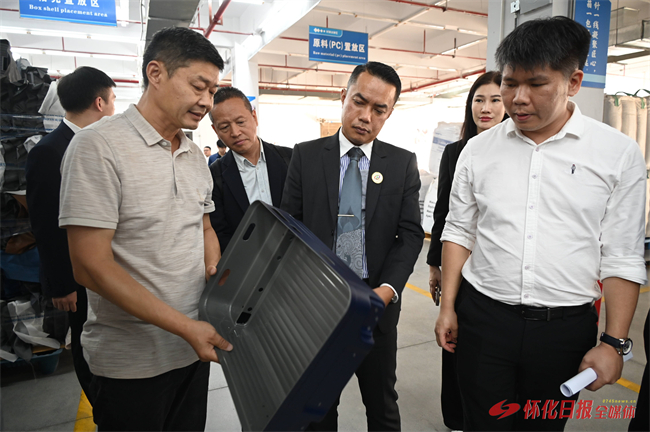
Chamlak Kanphet emphasized that the two sides have a high degree of complementarity in commodity demand. Thailand's high-quality agricultural products and specialty goods are widely popular in the Chinese market, while specialty products from Huaihua and even the whole province are needed by the Thai market. "This mutually matching demand creates natural cooperation momentum for bilateral trade," he said. He remarked that with the smooth operation of international corridors such as the China-Laos Railway, logistics efficiency between Huaihua and Nong Khai Province continues to improve, and the feasibility of cooperation has significantly increased. "I believe that in the near future, we will witness the implementation of a number of pragmatic cooperation projects and see tangible cooperation results," he added.
Regarding the reasons for deepening exchanges and cooperation with Huaihua, Chamlak Kanphet noted that in addition to its strategic position as a regional logistics hub, he valued Huaihua's potential and commitment to advancing regional coordinated development. "Huaihua not only has convenient transportation but also demonstrates an open and inclusive attitude toward collaboration. We look forward to taking this visit as a starting point to promote targeted matchmaking between enterprises in the two places, establish a regular cooperation mechanism, and jointly create a new model of local economic and trade cooperation between China and Thailand," he said.
This article is from Hunan Provincial Government. www.enghunan.gov.cn.
Translator: Yu Jiangjiang
Chinese source: hunantoday




 Hunan PSB Cyber Security Filing: No. 43010302000524