


The 2026 Overseas Chinese Media Chenzhou Tour was launched on September 6. Representatives from 18 overseas Chinese media outlets across 11 countries, including the Philippines, Côte d'Ivoire, Romania, Canada, and Australia, as well as China's Hong Kong and Macao, are scheduled to spend five days exploring various parts of Chenzhou to share the captivating stories of "Chenzhou Travel" with the world.
The 'dwarf technique'—with its crouching steps and nimble movements—showed incredible agility; the 'water-sleeve' flowed with effortless grace, ethereal as a celestial being; and the 'fire-breathing technique' sent dazzling flames leaping into the air, a truly stunning sight… That evening, the overseas Chinese media delegation watched an immersive Kunqu Opera show "Xiang Yu, Xiang Kun (An Encounter with Hunan Kunqu Opera)" at the Hunan Kunqu Opera Troupe. The elegant and melodious singing, along with the exquisite and nuanced performances, drew round after round of applause from the audience.
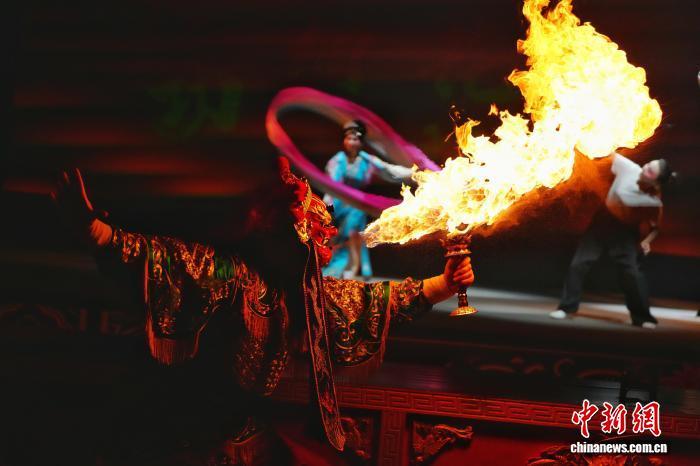
On September 6, the 2026 Overseas Chinese Media Chenzhou Tour was officially launched. The photo shows the performance of "Xiang Yu, Xiang Kun." (Photo/Yang Huafeng, Chinanews)
Kunqu Opera, named after its place of origin—Kunshan, Jiangsu—is one of the world's three oldest forms of opera, with a history of over 600 years. Known as the "ancestor of all operas," Kunqu holds a significant place in the history of Chinese literature, drama, music, and dance. After the mid-Ming Dynasty (1368-1644), Kunqu began to flourish in the Chenzhou area of Hunan, where it became known as "Xiangkun" (Hunan Kunqu Opera). In 2001, Kunqu Opera was listed as one of the first Masterpieces of the Oral and Intangible Heritage of Humanity by UNESCO.
However, the "Wu dialect" of Kunqu Opera differed greatly from the "Chu dialect" in Chenzhou, and Hunan Kunqu Opera once fell into obscurity because the "Wu dialect was difficult to understand and unacceptable for local audiences." In 1960, to preserve, carry forward, and develop the art of Hunan Kunqu Opera, the Chenzhou Xiangkun Troupe (later renamed the Hunan Kunqu Opera Troupe) was established and gradually grew into one of the eight major Kunqu troupes nationwide. Over more than six decades, the troupe has revived, adapted, and staged over sixty full-length operas and more than one hundred excerpted plays.
The show "Xiang Yu, Xiang Kun" tells the story of Liu Sheng, a Kunqu inheritor in the Ming Dynasty, who brought Kunqu back to his hometown at the urging of his mentor Tang Xianzu. By integrating Hunan's local charm and Chu-style rhythms into the rigorous "hand, eye, body, technique, and footwork" of Kunqu, he ultimately created Hunan Kunqu Opera and earned the recognition of his fellow villagers. Compared to the delicate and melodious Southern Kunqu and the bold and resounding Northern Kunqu, Hunan Kunqu Opera's music combines refined elegance common to the genre with a rustic character of its own. Beloved by the public, the opera was praised by Tian Han as "a golden phoenix flying out of a mountain hollow."
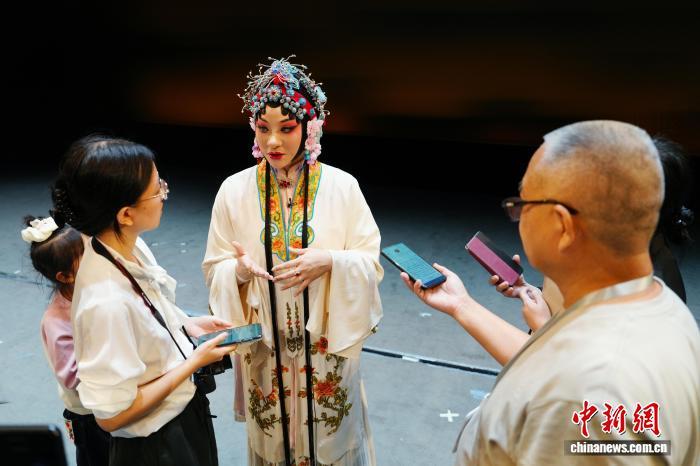
After the performance of "Xiang Yu, Xiang Kun," overseas Chinese media representatives interviewed an artist from the Hunan Kunqu Opera Troupe. (Photo/Yang Huafeng, Chinanews)
After the performance, Sheng Yun, a reporter from HK01, a popular online news portal, extended an invitation to Liu Jie, deputy head of the Hunan Kunqu Opera Troupe, hoping the troupe could perform in Hong Kong. "I have watched many performances of Kunqu Opera, Peking Opera, Yu Opera, and other traditional operas in Hong Kong, but this is my first time seeing Hunan Kunqu Opera, and it was stunning," Sheng Yun said. Hong Kong has a strong theater-going culture, and he hoped audiences there could experience the unique charm of Hunan Kunqu Opera, which differs from both Southern and Northern Kunqu.
Liu Jie noted that the troupe planned to perform in Hong Kong several times, but those plans were regrettably shelved due to scheduling conflicts. In the future, the troupe will actively promote performances in Hong Kong through cultural exchanges, intangible cultural heritage programs in schools, and other channels, showcasing the charm of Kunqu Opera to audiences in Hong Kong and the Guangdong-Hong Kong-Macao Greater Bay Area.
Through innovation and evolution, the Hunan Kunqu Opera Troupe has not only made the art form widely popular in China but has also frequently brought it to the international stage. The troupe was invited to the Edinburgh Festival Fringe in the UK to perform a Kunqu adaptation of "Romeo and Juliet," opening new paths for dialogue between Eastern and Western dramas.
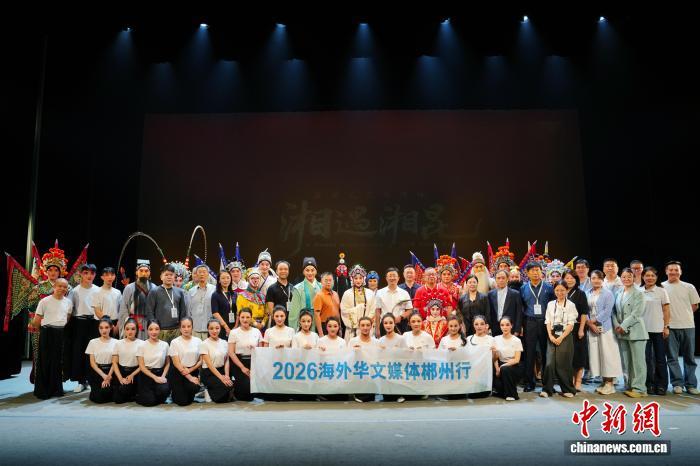
Overseas Chinese media representatives posed for a group photo with artists from the Hunan Kunqu Opera Troupe. (Photo/Yang Huafeng, Chinanews)
It is worth noting that this performance also broke down the "fourth wall" of a traditional theater. From the musicians in costume playing at the theater entrance to the performers who leaped into the audience to interact with them during the performance—all enhanced by modern sound, lighting, and digital projection technologies—the audience quietly became "characters in the play."
"Hunan Kunqu Opera has found a subtle balance," said Gao Jin, publisher of Romania's Overseas Chinese Newspaper of Europe. He noted that while much of the dialogue in the production incorporates elements of the Chenzhou dialect, it does not completely deviate from the rhythm of Kunqu opera—a delicate balancing act that takes real skill.
The event is co-hosted by the Publicity Department of the CPC Chenzhou Municipal Committee and the Hunan Branch of China News Service. Next, the overseas Chinese media representatives will visit sites such as the Mangshan Tourist Area, Yuhou Street, Gaoyiling Scenic Area, and Jiulong Water Village in Chenzhou to experience firsthand the charm of Hunan's natural landscapes and historical culture.
This article is from Hunan Provincial Government. www.enghunan.gov.cn.
Translator: Xiao Juan
Chinese source: Chinanews




 Hunan PSB Cyber Security Filing: No. 43010302000524