


Hunan has been home to a variety of renowned tea since ancient times, such as Anhua dark tea, Guzhang Maojian, Baojing golden tea, Shimen Yinfeng, Yuanling Jietan tea, Taoyuan daye tea, and Jianghua kucha. Spring is the very season to savor tea. Let's embark on a tea journey through Hunan.
Yuanling Jietan Tea
Yuanling County in Huaihua boasts a long history of tea planting. Its Jietan tea has been designated as an imperial tribute starting in the Tang Dynasty (618–907), hence the title of "Thousand-year-old Imperial Tribute Tea." Jietan tea has received the "Gold Prize of China Famous Tea for Century Expo Milan – Italy," and was served as a designated green brand for two sessions of the China-Africa Economic and Trade Expo. It is reputed as an "outstanding representative of China's high-end green tea" and has been collected by the National Museum of China as a sample of modern green tea.
Entering Jietan Village, with the Yuanjiang River flowing at the foot of the mountain, visitors may try their hand at picking tea leaves in an ecological tea garden, listen to the story of this "Thousand-year-old Imperial Tribute Tea," and taste a unique tea feast.
Recommended tea plantations: Jietan Village, Beirong Township.
Best harvest period: Late March – Mid-April.
Hands-on activities: Picking tea leaves and experiencing traditional tea culture.
Nearby attractions: Jiemuxi National Natural Reserve and Eryou Mountain.
Local delicacies: Yuanling sun-dried meat, Jiemuxi wild vegetables, and Jietan tea-scented duck.
Zhangjiajie Vine Tea
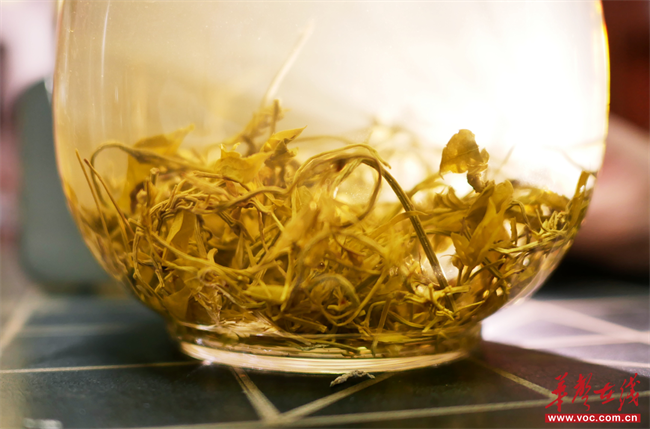
Zhangjiajie vine tea is known as "divine vine" and "longevity vine" by Tujia people, with a history dating back to the Tang Dynasty (618–907). Despite its name as "tea," it is actually a vine plant. It is good for throat and liver health. A newly-brewed cup of tea looks clear and bright, with indigo tea leaves unfolding in boiled water. The first sip carries a hint of astringency, soon followed by a sweet aftertaste.
On a leisurely weekend, you may stroll around the idyllic Longevity Wine Garden in Luotaping Township, handpicking fresh tea buds; or, experience intangible cultural heritage tea-making techniques at the Baima Mountain Vine Tea Park, immersing yourself in the sweet aftertaste of this vine tea.
Recommended tea plantations: Longevity Wine Garden in Luotaping Township, Yongding District.
Best harvest period: April – October (spring tea is the best).
Hands-on activities: Picking tea buds and experiencing traditional tea-making technique.
Nearby attractions: Tianmenjun Vine Tea Park on Baima Mountain and Zhumaxi Gorge.
Local delicacies: Tujia cured meat, He Zha (ground soybean porridge), and free-range chicken stewed with rock tripe.
(Photo/Tong Di)
Sangzhi White Tea
Sangzhi white tea is a pillar industry in Sangzhi County. With unique processing techniques, the tea features bright yellow color, mellow and sweet taste, subtle floral aroma, and lingering aftertaste. Besides, the tea product has a long shelf life, and gains value over time.
You may visit the local Bai Ethnic Culture Experience Hall, tasting a cup of Sangzhi white tea to savor the life philosophy reflected in tea tasting — "bitter, sweet, and then aftertaste", and watching a special tea art show integrated with Sangzhi folk songs.
Recommended tea plantations: Tea gardens in Renchaoxi Town and Hongjiaguan Bai Township.
Best harvest period: Late March – Mid-April.
Hands-on activities: Picking white tea leaves, and experiencing withering and drying techniques in tea-making process.
Nearby attractions: He Long's Former Residence and Badagong Mountain National Natural Reserve.
Local delicacies: Sandaocha (three-course tea) of the Bai ethnic group, Sangzhi cured meat, and rock tripe.

(Photo/Xiang Tao)
Rucheng Baimao Tea
Rucheng white tea is one of Hunan's four rare wild tea varieties. The tea plants grow in the primary and secondary forests in the Jiulongjiang National Forest Park. The tea leaves are big and downy, being rich in nutritive components and suitable for making tea.
You may visit the primary and secondary forests in the Jiulongjiang National Forest Park, appreciating Yao folk songs while exploring ancient wild tea plants. When you brew a pot of tea with hot spring water, you can witness a "water ballet" as the tea leaves dance.
Recommended tea plantations: Ecological tea gardens around the Jiulongjiang National Forest Park.
Best harvest period: Around Qingming Festival, which falls on April 5 this year.
Hands-on activities: Picking baimao tea leaves and exploring wild tea plants.
Nearby attractions: Jiulongjiang National Forest Park and hot springs.
Local delicacies: Rucheng pressed salted duck, stewed toufu, and Yao-style youcha (oil tea).
This article is from Hunan Provincial Government. www.enghunan.gov.cn.
Translator: Pang Yuehui
Chinese source: hunantoday



 Hunan PSB Cyber Security Filing: No. 43010302000524