


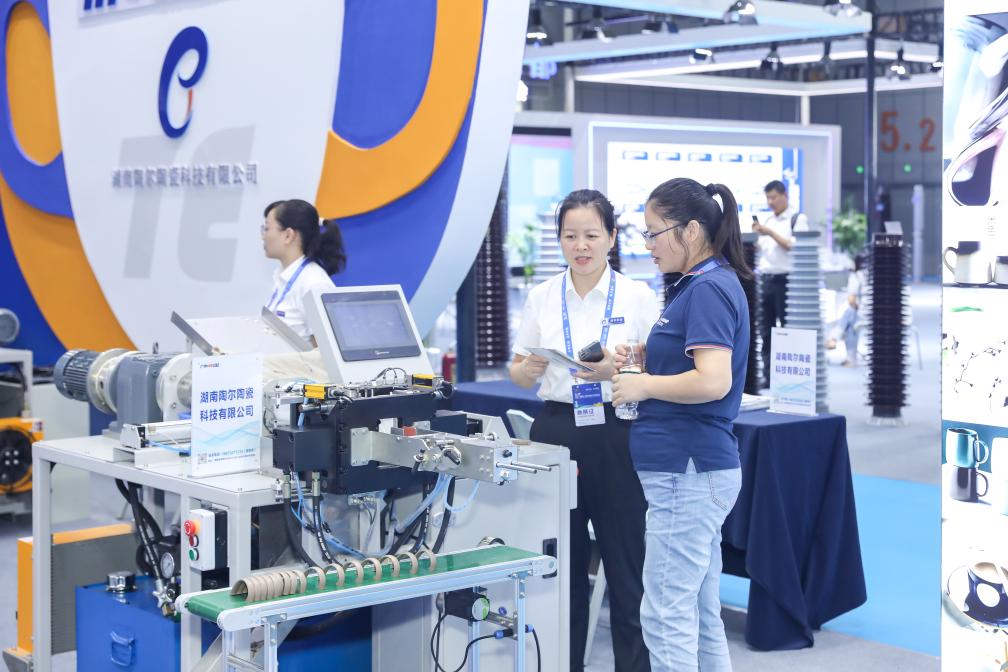
On September 29, a staff member of Hunan Tao'er Ceramic Technology Co., Ltd. demonstrates an automated ceramic cup earphone machine. (Photo provided by the Publicity Department of the CPC Liling Municipal Committee)
The 2025 Hunan (Liling) International Ceramic Industry Expo was held in Liling from September 29 to October 3. Reporters found during their visits that the traditional ceramic industry is taking on new vitality.
In recent years, automated equipment such as robotic arms, 3D printing, and automatic glazing machines have been adopted by many ceramic enterprises in Liling. Since the beginning of this year, intelligent production lines, including the Taorun Phase II Innovation and Intelligent Manufacturing Center, and the annual 10,000-tonne automated production line of the Hunan New Century Ceramics, have also been completed and put into operation. Six ceramic enterprises in Liling made the 2025 list of Hunan's provincial-level intelligent factories, including industry leaders such as Hunan Hualian China Industry Co., Ltd. and Hunan Yangdong Porcelain Insulators & Electric Co., Ltd.
At present, nearly 100 ceramic production enterprises in Liling have invested a total of nearly 400 million CNY in automation and intelligent upgrades, introducing and installing close to 1,100 sets of automated and intelligent production equipment. Intelligent production has now achieved economies of scale.
In addition to household porcelain, electrical porcelain is also a key part of Liling's ceramics industry. In 2024, the city produced nearly 30% of the nation's electrical porcelain and over 40% of its UHV insulators. Liling is also home to 76 electrical porcelain and electrical equipment enterprises above designated size.
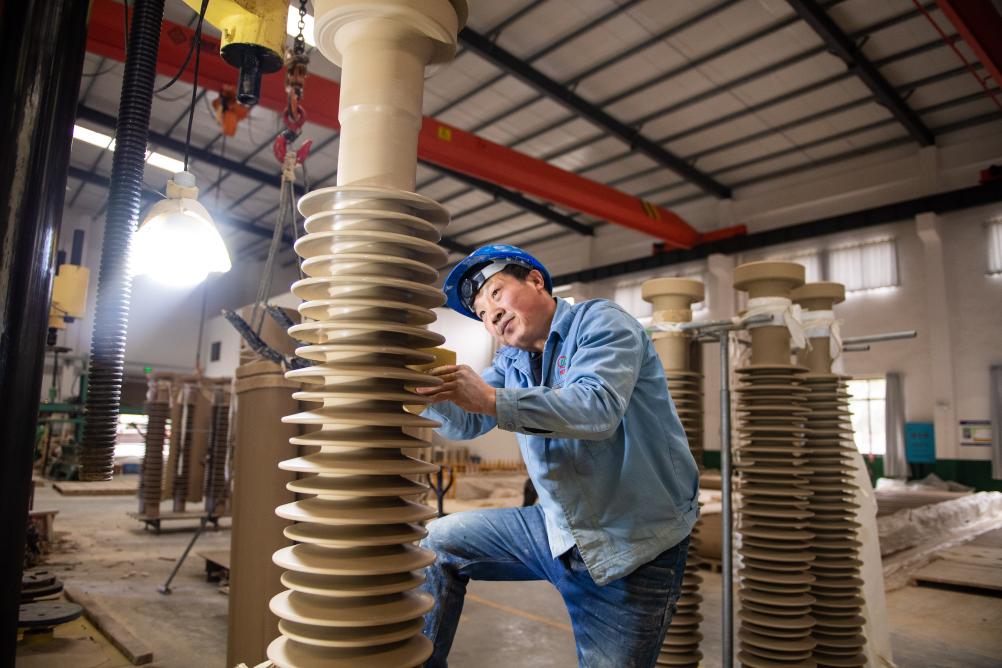
A worker manufactures a porcelain insulator at the production workshop of Hunan Yangdong Porcelain Insulators & Electric Co., Ltd. in Liling. (Photo/Chen Sihan, Xinhua)
The upstream and downstream of the electrical porcelain industry are also continuously expanding in Liling, with technological upgrades reaching into the raw materials sector. "Replacing traditional bauxite with industrial alumina is an important R&D direction for the entire electric porcelain industry," said Li Mingqi, assistant general manager of the Liling Huaxin Insulator Technology Co., Ltd. Currently, domestic electrical porcelain enterprises mainly use bauxite. Huaxin is conducting technical research to replace bauxite with industrial alumina, which can significantly improve the mechanical strength, insulating properties, and corrosion resistance of electric porcelain.
In June this year, Lilling fully launched the construction of a ceramics "1+N" R&D and design platform, integrating resources from universities, research institutions, enterprises and other parties to promote innovative development of the ceramics industry.
Reporters felt during local interviews that the new "Ceramics+" model enables advanced manufacturing and cultural tourism industries to empower each other.
"Visiting ancient kilns and museums, doing pottery, watching 'National Color Liling' shows, hunting for bargain-priced porcelain, eating stir-fried dishes —Liling offers beautiful scenery, delicious food, and fun experiences."The comment by an out-of-town visitor reflects the effects of Liling's integration of ceramics and cultural tourism.
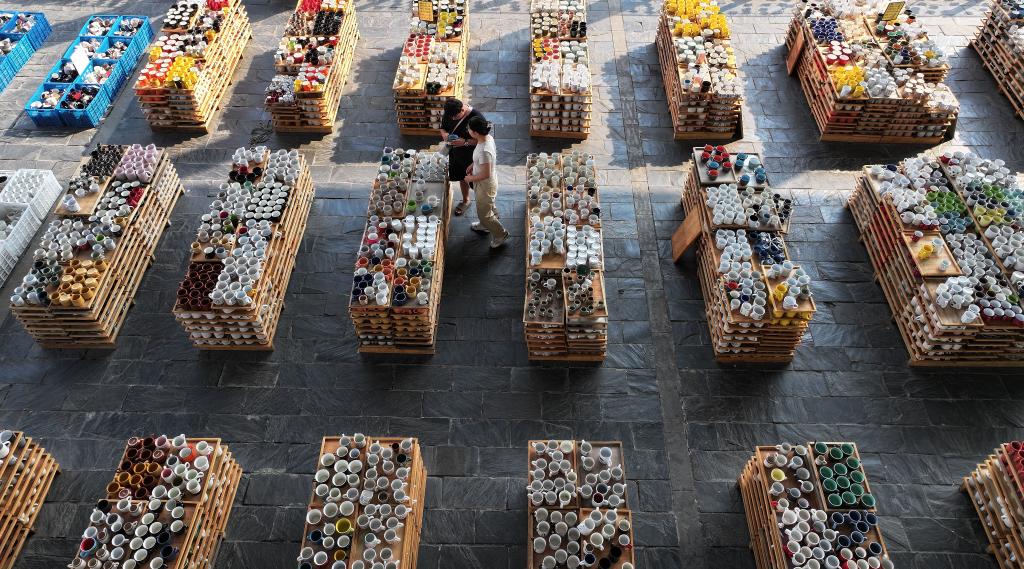
Tourists select porcelain items at a "porcelain hunting" area in Liling on September 26, 2024. (Photo/Zhao Zhongzhi, Xinhua)
At Hunan Liling Shang Fang Yao Ceramics Co., Ltd., visitors can first tour the workshop to explore ceramic production, then go to the studio to make their own porcelain, experiencing processes such as shaping and painting. "The production line becomes a scenic line; this kind of integrated development allows ceramics to shine in a new light," said Zhang Huamin, head of the Hunan Liling Shang Fang Yao Ceramics Co., Ltd.
More than 20 national- and provincial-level industrial tourism brands, such as China Ceramics Valley and Liling Kiln, have transformed the entire process of Liling ceramics from clay to art into experiential scenes. The former Qunli Porcelain Factory site and Guoguang Porcelain Factory have been turned from industrial ruins into cultural tourism assets. "Come to Liling to hunt for bargain-priced porcelain" has become a popular tourism IP. In just the first quarter of this year, the number of tourists coming to Liling to "hunt for porcelain" exceeded three million.
The Liling ceramics industry is not only a main pillar of the county's industry but also plays a core role in driving employment, activating cultural tourism, expanding markets, and enhancing urban competitiveness, becoming a "powerful engine" for high-quality development of the county economy. "The ceramics industry directly employs nearly 200,000 people, covering the entire chain from technical R&D, manufacturing, to logistics and sales, serving as an important channel for local people to increase their income and for stabilizing county employment," said Wen Shuilin, spokesperson of the Liling Ceramics Development Research Center.
Chinese source: Xinhua



 Hunan PSB Cyber Security Filing: No. 43010302000524