

Hunan Facts
Home > About Hunan > Hunan Products
Zhijiang Dong Autonomous County — "Land of Chinese Wax"
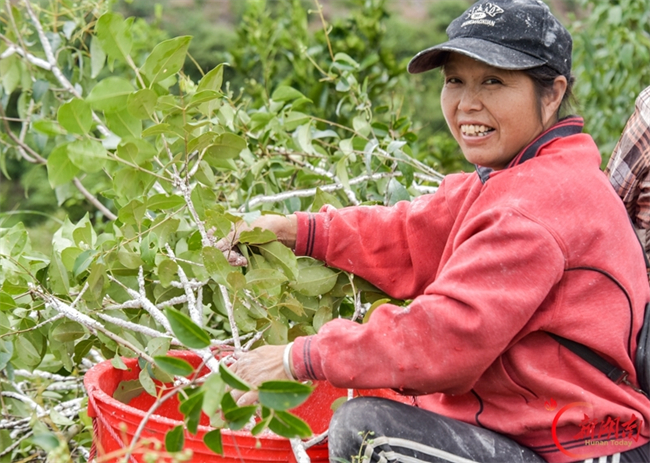
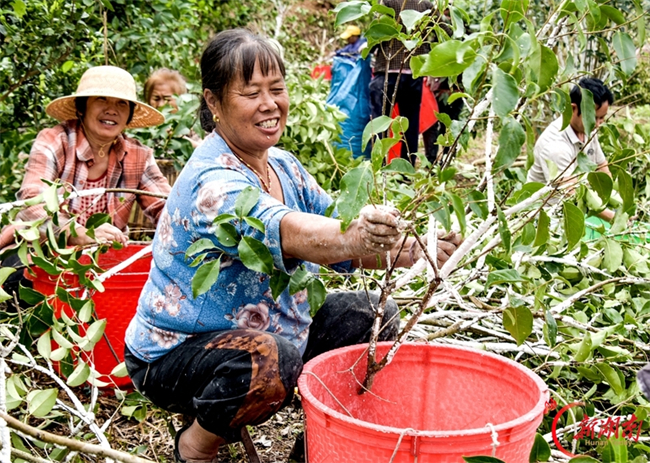
Villagers collect Chinese wax in Tangjiaqiao Village, Aitouping Township, Zhijiang Dong Autonomous County. (Photo/Yang Jiashen)
Zhijiang Dong Autonomous County, known as a "land of Chinese wax," produces about half of China's total white wax output. The Chinese wax, also known as insect white wax or pela wax, produced here is widely used in various applications, creating a highly representative industry that benefits the local people. During the Chushu and Bailu solar term periods, Chinese ash branches in the production areas are commonly seen wrapped with glittering, snow-white wax, earning the region the poetic name of "August Snow in the Dong Township." Currently, there are over 50,000 mu (approximately 3,335 hectares) of Chinese ash forests, of which 12,000 mu (approximately 800.4 hectares) are used for the production of Chinese wax, yielding more than 900 tonnes of Chinese wax annually.
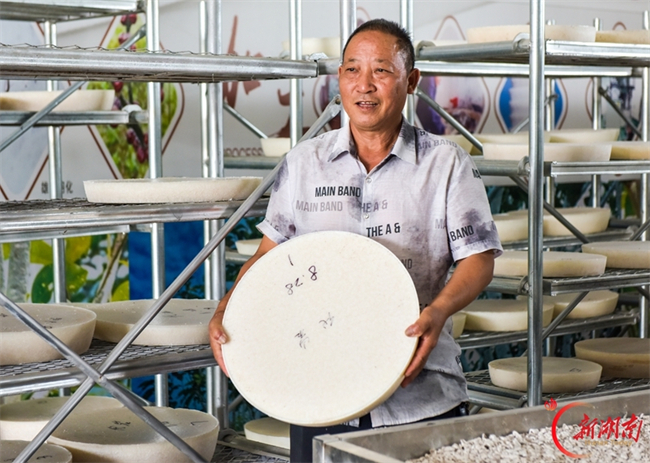
A villager shows a newly-made block of refined Chinese wax at a Chinese wax processing workshop in Tangjiaqiao Village, Aitouping Township, Zhijiang Dong Autonomous County. (Photo/Yang Jiashen)
Zhijiang Dong Autonomous County, known as a "land of Chinese wax," produces about half of China's total white wax output. The Chinese wax, also known as insect white wax or pela wax, produced here is widely used in various applications, creating a highly representative industry that benefits the local people. During the Chushu and Bailu solar term periods, Chinese ash branches in the production areas are commonly seen wrapped with glittering, snow-white wax, earning the region the poetic name of "August Snow in the Dong Township." Currently, there are over 50,000 mu (approximately 3,335 hectares) of Chinese ash forests, of which 12,000 mu (approximately 800.4 hectares) are used for the production of Chinese wax, yielding more than 900 tonnes of Chinese wax annually.
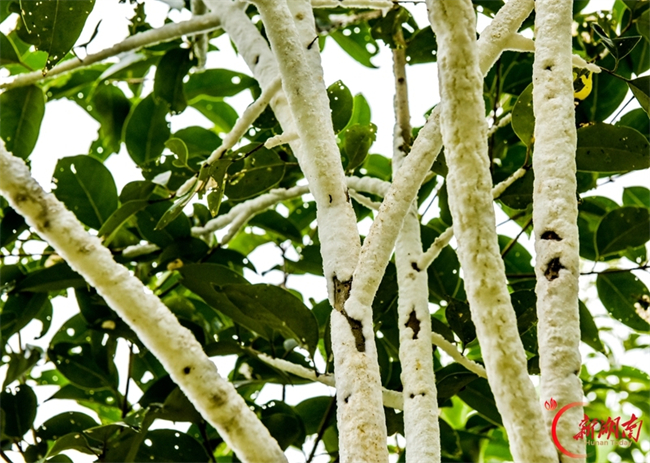
Chinese ash branches are coated with snow-white wax in a Chinese ash forest in Tangjiaqiao Village, Aitouping Township, Zhijiang Dong Autonomous County, creating a bumper harvest scene. (Photo/Yang Jiashen)
Zhijiang Dong Autonomous County, known as a "land of Chinese wax," produces about half of China's total white wax output. The Chinese wax, also known as insect white wax or pela wax, produced here is widely used in various applications, creating a highly representative industry that benefits the local people. During the Chushu and Bailu solar term periods, Chinese ash branches in the production areas are commonly seen wrapped with glittering, snow-white wax, earning the region the poetic name of "August Snow in the Dong Township." Currently, there are over 50,000 mu (approximately 3,335 hectares) of Chinese ash forests, of which 12,000 mu (approximately 800.4 hectares) are used for the production of Chinese wax, yielding more than 900 tonnes of Chinese wax annually.
Chinese source: hunantoday