

History and Culture
Home > About Hunan > Celebrities
Jiang Yiwu
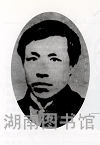
Photo from Hunan Library
Jiang Yiwu (1885-1913), also known as Baobo, or Bokui, was born in Lixian County, Hunan Province.
Early Life
Born in a poor peasant family, Jiang Yiwu did not go to school until 6. In 1904, Song Jiaoren came to Changde to plan an uprising, and Jiang, who was studying there, supported Song enthusiastically. That autumn, the Changsha Uprising failed and Jiang was expelled from school as a suspected participant in the uprising. In 1906, Jiang joined the Chinese Revolutionary League.
In 1909, Jiang established the Commerce Newspaper to support revolutionary activities. Later, he joined the army of the Qing Dynasty in order to agitate the soldiers for revolt.
Pioneer of Wuchang Uprising
In 1912, after "the Huanghuagang Uprising" (the March 29th Guangzhou Uprising) failed, Jiang sent Zhan Dabei and Yang Yuru to Shanbei to meet Song Jiaoren to plan another uprising. On October 10th, the "Wuchang Uprising" broke out. The revolutionaries occupied Wuchang, Hankou and Hanyang. Jiang was appointed as military vice minister. On November 27th, Hanyang was lost. Jiang was appointed as commander-in-chief to fight against the armies of the Qing Dynasty.
In April 1912, Yuan Shikai became president of the ROC (Republic of China) and attempted to restore the Chinese monarchy. Jiang refused any governmental post offered by Yuan. On August 25th, the KMT was established in Beijing and Jiang was elected senator.
Wuchang Uprising in Octoberk played a keyrole in overthrowing the long feudal system in which the Literary Society and the Progressive Group in Hubei New Army were the main forces.
As President of the Literary Society and Commander in chief of the army Jiang Yiwu played a leading role in creating the organization , strengthening the forces, uniting the Progressive Group, planning the uprising and seeking the development of the Society.
On March 22nd, 1913, Song Jiaoren was assassinated, which aroused a strong anti-Yuan movement.The KMT launched another round of nationwide uprisings. On July 24th, Jiang decided to start another revolt. The plan was leaked and he was put on the most wanted list. On July 21st, Hunan Province declared independence and Jiang commanded the army on a punitive expedition against Yuan. On August 29th, Jiang was arrested in Quanzhou, Guangxi Province. On September 9th , 1913, Jiang was executed in Guilin, Guangxi Province.
In 1917, Jiang's remains were relocated and buried on Yuelu Mount, Changsha, Hunan Province.
Translator: Pang Yuehui
Chinese source: hunan.gov.cn